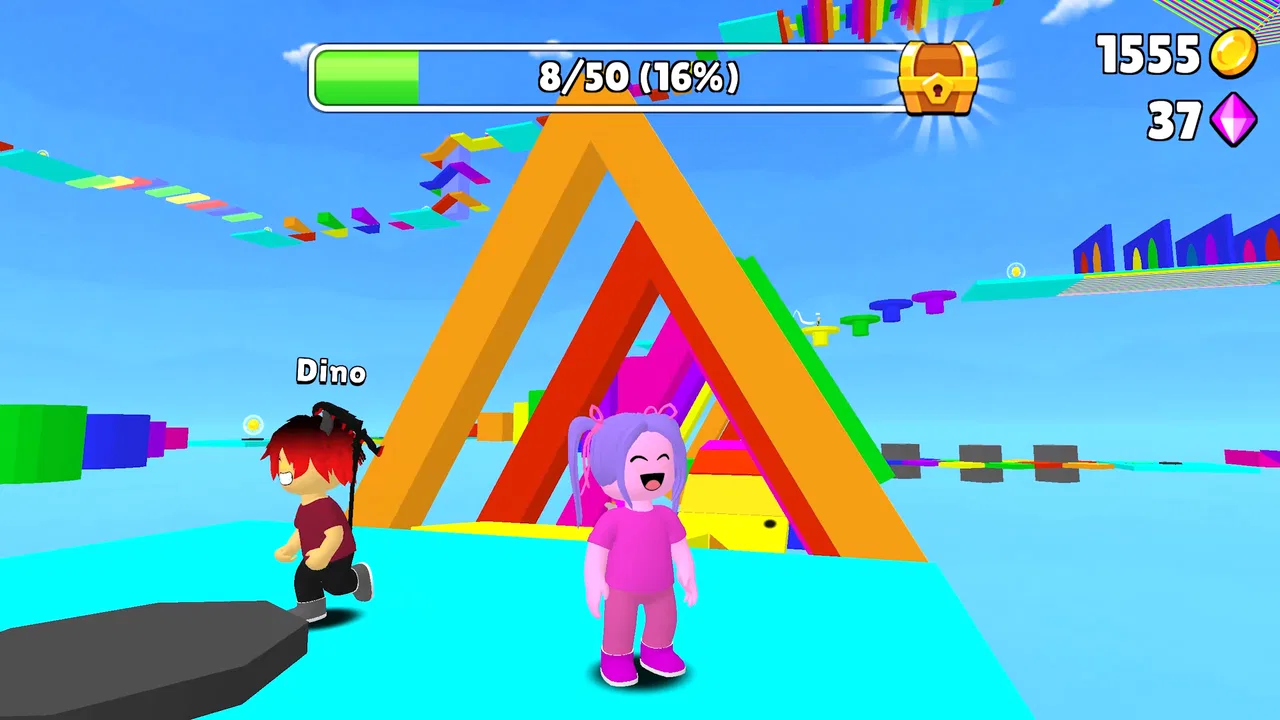
Obby Parkour: Runner Game
- 4.5
- Rating
- 10.00M
- Installs
- Free
- Price

 Analysis by App-foxy
Obby Parkour: Runner Game is the kind of adventure game I open when I want a quick test of timing rather than a long story or complicated setup. Its central idea is simple: guide a character through an obstacle course by running and jumping across platforms. That narrow focus is also its strongest quality. Instead of asking me to learn a large world, it puts attention on movement, mistakes, and the satisfaction of clearing the next difficult section.
Developed by Kids Games LLC, the game is free to start and is suitable for Everyone. It has reached more than ten million installs and holds a 4.5 average from roughly eighty thousand ratings, which suggests that its straightforward obstacle-course format has found a broad audience. I can see why: the controls and objective are easy to understand, while the challenge comes from executing actions at the right moment.
The important thing to understand is that this is a precision-focused parkour game, not a traditional adventure with exploration as its main reward. If you enjoy trying the same jump again until your timing improves, it can be an entertaining little routine. If you want dialogue, character development, puzzles with several possible solutions, or a large world to investigate, its focused design may feel limited.
You May Also Like

 Pandora - Music & Podcasts
Pandora’s Music Is Easy to Start, but Harder to Recover
Pandora’s strength is its low-effort path from a seed to a station. Its weak spot is how much confidence it asks you to place in connection, setup, and quiet recovery.

 AccuWeather: Weather Radar
AccuWeather Review: A Quick, Clear Forecast for Everyday Decisions
For everyday plans, the best forecast is the one you can understand quickly. AccuWeather makes rain timing, radar, and local conditions easy to act on, with a few trade-offs.

 Hill Climb Racing
Why Hill Climb Racing Still Turns Crashes Into One More Run
A tiny car, a bumpy hill and one more upgrade: Hill Climb Racing keeps resurfacing because its simple chaos makes every near-miss feel personal.

 AliExpress - Shopping App
AliExpress Makes Global Shopping Feel Personal, but Shoppers Bear the Risk
AliExpress turns a global marketplace into a pocket-sized discovery engine. Its reach is useful, its shopping loop compelling, and its trade-offs easy to miss.

 Lords Mobile: Kingdom Wars
Lords Mobile Is a Kingdom-Building Routine, Not a Quick Match
A case-by-case verdict on the building, battles, device demands, and social commitments that make Lords Mobile rewarding for some players and exhausting for others.

 PDF Scanner app - TapScanner
TapScanner Makes Paperwork Easier to Capture, Check, and Share
TapScanner makes scanning with a phone feel less like a rescue operation and more like a dependable step in getting work done. Its capture tools are useful, though not flawless.
More From Our News Desk
View All News


Why the obstacle-course format works
The defining capability here is the ability to run and jump through a platform-based obby course. In practice, that means the game turns movement into the entire problem. A platform may look reachable, but the real question is whether I begin the jump at the right point, keep my direction steady, and land without overcorrecting.
That makes each section feel more like a short coordination exercise than a passive trip from one checkpoint to another. The design is accessible because the goal is immediately visible. I do not need to remember a complicated quest or understand a deep upgrade tree before playing. I can start, read the next obstacle, attempt it, and decide whether my mistake came from poor timing or an imprecise movement.
This simplicity is particularly useful on a phone. A mobile game can become tiring when it places too many buttons or menus between the player and the action. Here, the appeal comes from getting into the course quickly. The game’s store summary describes an obstacle course built around running and jumping, and that is exactly the lens through which I would judge it: how clearly does it present the next movement, and how willing am I to repeat it after a failed attempt?
For younger players, the Everyone age rating and uncomplicated premise make the game easy to approach. For adults, the same simplicity can work as a short break between other tasks. I would not describe it as a deep adventure, but I would describe it as an approachable reflex challenge that does not demand a large time commitment before the basic idea becomes clear.
Reading the course instead of rushing blindly
My most useful adjustment was to stop treating every obstacle as a race. The temptation is to hold the movement direction and jump as quickly as possible, especially when the next platform appears close. That approach often turns a manageable section into a careless miss. A better routine is to pause mentally before each jump, identify the landing area, and use the previous attempt to change one thing at a time.
This matters because platform games punish vague corrections. If I change direction repeatedly while airborne, I am no longer making a deliberate decision; I am reacting late. The more reliable method is to line up before the jump, commit to the intended path, and reserve corrections for situations where the landing is clearly drifting away from the platform.
That approach also gives the game a small learning loop. A failed attempt is not automatically frustrating if I know what caused it. I might have jumped too early, approached at an awkward angle, or tried to move again when the platform was already beneath me. Treating each miss as a specific lesson makes repeated runs feel purposeful rather than random.
How I would use it during an ordinary day
Imagine having a few minutes while waiting for an appointment or taking a break from studying. This is where the game makes the most sense to me. I can play a short stretch, focus on a few jumps, and stop without needing to remember a complex narrative. The immediate objective gives the session a clear beginning and end, even if I choose to retry a difficult section several times.
It can also work as a casual game for a child who prefers active interaction over watching a screen. I would still recommend that an adult explain the basic movement and pay attention to how the child responds to repeated failures. The Everyone rating makes the content broadly accessible, but accessibility does not mean every player will enjoy the same level of challenge. Some children will like mastering a jump; others may lose interest if progress depends on repeated attempts.
For me, the best sessions are short and intentional. I would not open it expecting a complete evening of varied entertainment. I would open it when I want a compact obstacle challenge, particularly when I have enough patience to repeat a section instead of abandoning it after one mistake.
Practical habits that make the jumps easier
One useful habit is to separate observation from movement. Before committing to a jump, I look for the safest landing area rather than the most direct route. A platform with more room may be a better target than a narrow edge, even if reaching it takes a slightly less aggressive approach. This is a small change, but it reduces the number of attempts lost to unnecessary risk.
Another is to avoid changing several variables after a failure. If I jump later, alter direction, and change my speed all at once, I cannot tell which adjustment helped. I prefer to change the takeoff timing first. If that does not work, I then reconsider alignment. This turns the game into a simple personal experiment and helps prevent frustration.
I also find it useful to stop after a run of careless attempts. When I am rushing, I tend to repeat the same error while believing I am trying something new. A short pause can restore attention, which is more valuable here than playing continuously. The game rewards concentration, so longer sessions are not automatically better sessions.
These are not hidden buttons or advanced systems; they are ways of getting more from the game’s central mechanic. The important trade-off is that the player supplies much of the depth. The app provides the course and the movement challenge, while the satisfaction comes from how carefully I study and refine my own approach.
Where it fits among mobile adventure games
Compared with story-driven adventure games, Obby Parkour: Runner Game is much more immediate and much less narrative-focused. A story game may reward exploration, conversations, collecting, or discovering what happens next. This one rewards a successful movement sequence. If I want to relax by following a plot, I would choose a different type of game. If I want to test my reactions with a clear physical objective, the obby format is a better match.
It also differs from endless runners. Endless runners usually emphasize continuous forward motion and quick reactions to obstacles that arrive in sequence. An obby course feels more deliberate because the player is trying to negotiate individual platforms and jumps. That can make failure feel more personal: I am not simply overwhelmed by speed; I can often identify the exact movement that went wrong.
Compared with large platform adventures, this game is easier to pick up but offers a narrower range of activities. There is less to manage, which is helpful for younger or casual players, but it also means that players seeking exploration or character progression may run out of reasons to continue sooner. The game’s strength is concentration, not variety.
The free price lowers the barrier to trying it. However, in-app purchases range from $0.99 to $10.99 per item, so I would approach optional spending carefully, especially if a child is using the device. I would first decide whether the basic obstacle-course experience is enjoyable without purchases. A free download is useful for sampling the core loop, but it should not be confused with unlimited value for every type of player.
What the version and device requirements mean
The current version is 7.0.7.278, and the minimum operating system is Android 7.0. That makes the game relevant to people using older Android devices, although actual comfort will still depend on the phone or tablet’s general condition. A device that struggles with touch response or has a worn screen can make a timing-based game feel harder than it should.
Before judging my own skill, I would check whether the device responds consistently to taps and swipes. In a platform game, a delayed or missed input can look like a bad jump. Playing in a stable position, keeping the screen clean, and avoiding accidental touches around the edges are simple practical steps that matter more here than they would in a turn-based game.
I would also keep expectations realistic about the game’s scope. The version number indicates an established app rather than a first experiment, but it does not change the basic identity of the experience. The game remains centered on obby-style movement. Updates may improve the product over time, yet I would choose it because I want that core format, not because I expect it to become a different kind of adventure.
Where the design may test your patience
The same repetition that helps a player improve can become the main source of friction. When I understand why I failed, another attempt feels worthwhile. When a jump feels difficult without giving me a clear lesson, the loop becomes less satisfying. Players who prefer constant novelty may find the focused structure repetitive, particularly if they are not naturally interested in precision platforming.
Touch controls can also be less forgiving than physical buttons. Even with a well-designed course, a small finger movement may not feel as exact as a controller input. That is not a flaw unique to this game, but it is important when deciding whether the format suits you. I would recommend trying it on the device where it will actually be played rather than assuming that a familiar platform-game idea will feel identical on every screen.
The free-to-play structure is another consideration. The game costs nothing to begin, while individual in-app purchases can reach $10.99. I would not let the presence of optional items decide whether the core game is worthwhile, but I would set spending boundaries before handing the device to a child. The most sensible approach is to treat purchases as optional extras and evaluate the movement challenge on its own.
There is also a difference between being suitable for Everyone and being ideal for everyone. The age rating makes the content broadly approachable, but the required patience may not suit very young players who expect immediate success. Likewise, an experienced gamer may find the entry point too simple if they are searching for complex systems. The game works best when the player values small improvements in timing.
Who gets the most from this game
I think the strongest audience is made up of casual players, children who enjoy obstacle courses, and anyone who likes short skill-based challenges. It is especially suitable for someone who wants a game with a clear objective and little preparation. The broad install base and strong average rating suggest that the format has wide appeal, but I would still make the choice based on play style rather than popularity alone.
It is a good fit if you enjoy saying, “I know what I did wrong; let me try once more.” That attitude is central to the experience. The game provides a direct connection between attention and progress, so improvement feels earned even when the individual challenge is small. It can be a pleasant way to practice patience without the complexity of a full platform adventure.
I would skip it if your priority is storytelling, open exploration, multiplayer interaction, or a large collection of unrelated activities. I would also look elsewhere if repeated platform attempts quickly feel like work. A more narrative-driven adventure would offer better value for someone who wants discovery, while a controller-based platformer may be preferable for a player who needs highly precise physical input.
Parents choosing it for a child should consider two separate questions: is the content age-appropriate, and does the child enjoy retrying obstacles? The first answer is supported by the Everyone rating. The second depends on personality. I would let the child try the basic course before considering any in-app purchase, then decide whether the game encourages focused play or simply produces frustration.
My recommendation after focusing on the core loop
After spending time with its obstacle-course approach, I see Obby Parkour: Runner Game as a focused, accessible adventure game rather than a broad all-purpose mobile title. Its value comes from the clarity of its challenge: run, jump, observe the result, and refine the next attempt. That clarity makes it easy to recommend to the right person, but it also makes the limitations obvious.
For a free game, it offers a low-risk way to discover whether obby platforming suits you. I would begin without spending money, play long enough to see whether the repetition feels rewarding, and use the practical habits above to separate genuine difficulty from rushed inputs. If the game makes you more attentive to each landing, it is doing its job well.
My final view is positive but specific. I recommend it to players who want compact timing challenges and to families looking for an approachable platform game rated for Everyone. I would not recommend it as a replacement for a story-rich adventure or a deep platformer. Its best feature is not variety; it is the simple satisfaction of turning one failed jump into a successful one.
FAQs for Obby Parkour: Runner Game
01What is Obby Parkour: Runner Game about?
Obby Parkour: Runner Game is an exciting platform game that challenges players to navigate through various obstacle courses. With vibrant graphics and engaging levels, players must run, jump, and dodge obstacles to reach the finish line. It's designed for both casual gamers and those seeking a thrilling parkour experience.
02Is Obby Parkour: Runner Game free to play?
Yes, Obby Parkour: Runner Game is free to download and play. However, it may include in-app purchases for items or enhancements that can improve the gaming experience. These purchases are optional, and players can enjoy the game fully without spending money.
03What are the system requirements for Obby Parkour: Runner Game?
Obby Parkour: Runner Game requires a device with at least Android 5.0 or iOS 10.0. It’s optimized for smooth performance on both platforms, but players should ensure they have enough storage space and a stable internet connection for the best experience.
04Can I play Obby Parkour: Runner Game offline?
While Obby Parkour: Runner Game offers some offline features, an internet connection is recommended for accessing all game modes and updates. Playing online also allows users to compete in leaderboards and participate in special events and challenges.
05Are there any parental controls in Obby Parkour: Runner Game?
Yes, Obby Parkour: Runner Game includes parental control options. Parents can restrict in-app purchases and set time limits to ensure a safe and controlled environment for younger players. The game is designed to be family-friendly and suitable for all ages.
Pros
- Intuitive controls for easy navigation.
- Vibrant graphics enhance gameplay experience.
- Challenging levels keep users engaged.
- Frequent updates with new content.
- Suitable for all age groups.
Cons
- Contains in-app purchases for progression.
- Occasional ads disrupt the flow.
- Requires internet for some features.
- Limited customization options.
- May drain battery quickly on older devices.

Obby Parkour: Runner Game
Gallery